
Online learning does not only change where students learn. It also changes how they need to learn. When students are given more freedom over their schedule, pace, and study routine, that flexibility can be a major advantage. But it also means students need more than subject knowledge alone. They need to know how to plan, stay or even improve their focus, monitor their understanding, ask for help, and adjust when a strategy is not working. That broader ability is called self-regulated learning, or SRL.
Research reviews and meta-analyses show that SRL is closely tied to learning success[1][2] and that SRL interventions can improve outcomes in online and blended learning environments[3].
At EduWW, this matters because our curriculum is self-paced by design.
Students can move through lessons more flexibly, but they are not left without structure.
As our current model explains, self-pacing is supported by deadlines, progress tracking, and tutor guidance. That balance between flexibility in learning and support is exactly where SRL becomes most important.
What Is Self-Regulated Learning?
Self-regulated learning is the ability to actively manage one’s own learning process.
In simple terms, it means that students do not just wait to be told what to do next.
They:
- set goals,
- choose strategies,
- monitor their progress,
- reflect on results, and
- make adjustments when needed.
Importantly, SRL is not just about discipline or independence.
A major review describes SRL as including cognitive, metacognitive, behavioral, motivational, and emotional or affective aspects of learning. In other words, SRL includes not only how students study, but also how they manage effort, confidence, frustration, attention, and persistence.
That is why SRL is such a valuable skill in both online K-12 education, and education as a whole.
A student may know the content of a lesson, but still struggle if they cannot organize their time, notice misunderstandings early, recover after setbacks, or seek support when needed.
On the other hand, students who develop SRL are learning something larger than a single subject: they are learning how to learn.
The Main Models of SRL Explained Simply
Here are the theoretical models that explain the concept of SLR.
Zimmerman’s Cyclical Model
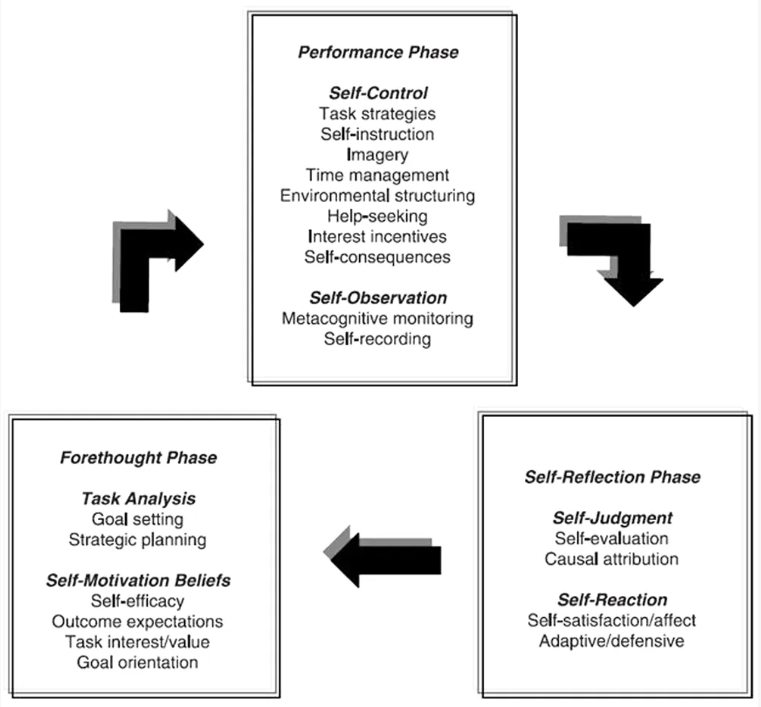
Image taken from A Review of Self-regulated Learning: Six Models and Four Directions for Research[5]
Zimmerman’s model[4] presents SRL as a repeating cycle with three phases:
- forethought,
- performance, and
- self-reflection.
In the forethought phase, students plan, set goals, and decide how to approach a task.
In the performance phase, they put strategies into action and monitor themselves while working.
In the self-reflection phase, they evaluate the result and decide what to improve next time.
This model remains one of the clearest ways to explain SRL because it shows that success is rarely about one perfect study session.
It is about repeatedly planning, acting, checking, and adapting.
Winne and Hadwin’s Feedback Model
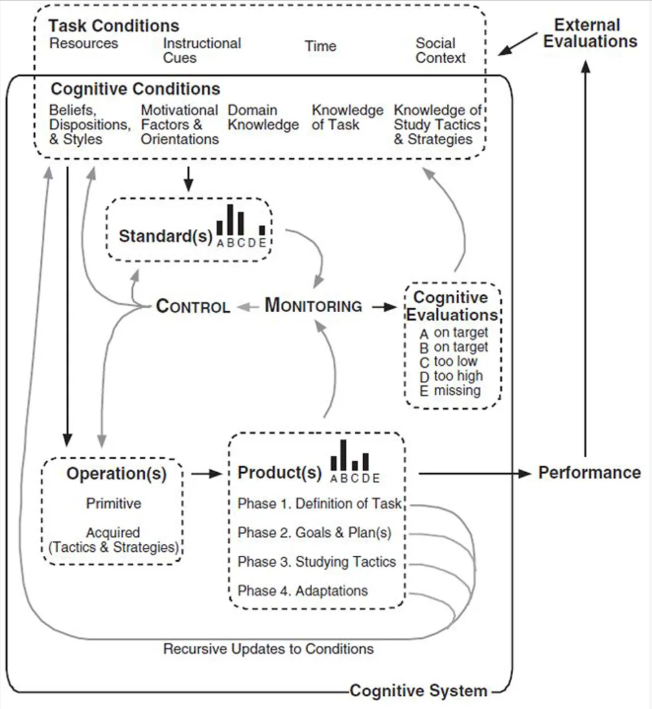
Image taken from A Review of Self-regulated Learning: Six Models and Four Directions for Research[5]
Philip Winne and Allyson Hadwin view SRL as a feedback loop in which students constantly process information.
They see SRL mostly from the perspective of metacognitive strategies.
They outline four recursive stages:
- Task Definition: Understanding what the task demands;
- Goal Setting and Planning: Deciding what needs to be done and how;
- Strategy Enactment: Applying learning strategies;
- Adaptation: Making changes based on feedback or results.
This model highlights the role of monitoring and feedback.
Additionally, SRL can be understood by 5 facets called COPES.
They represent some kind of internal mechanics of your brain while you study or work on a project.
| Element | What it means | Simple Example |
| Conditions | The “Environment.” What you have and what is stopping you. | You have a textbook (resource), but only 30 minutes to study (constraint). |
| Operations | The “Actions.” The actual mental work you do to learn. | Highlighting key terms, making a mind map, or quizzing yourself. |
| Products | The “Results.” The actual “stuff” your brain creates. | A finished essay, a memorized formula, or a new understanding of a concept. |
| Evaluations | The “Check-up.” Comparing what you did to what was required. | Realizing your essay is too short or checking your practice test answers. |
| Standards | The “Goal.” The rules or requirements you’re trying to meet. | The grading rubric or the “A” grade you want to achieve. |
Operations, or the “actions” of your mental work can be further broken down by the SMART model.
These are the specific cognitive tools you use:
- Searching: Looking for information in your memory or a book,
- Monitoring: Checking if you actually understand what you just read,
- Assembling: Connecting new info to things you already know,
- Rehearsing: Repeating info to make it stick (like flashcards),
- Translating: Changing the info into your own words.
Students don’t just move step by step. They cycle back when they realize their plan isn’t working.
For example, if a student notices low quiz scores after trying only to reread notes, they might adapt by switching to practice testing.
Pintrich’s Model of SRL
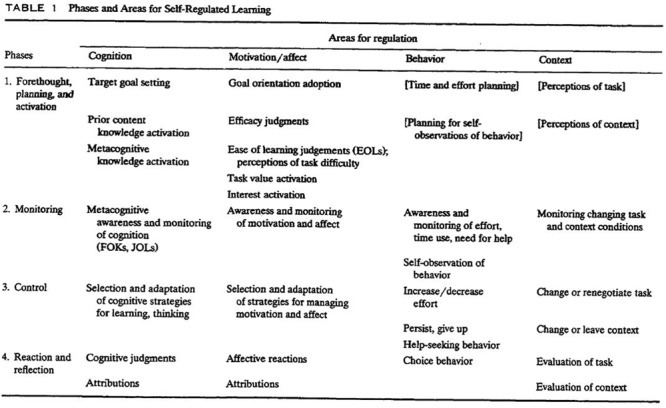
Image taken from A Review of Self-regulated Learning: Six Models and Four Directions for Research[5]
Pintrich’s model broadens the picture by showing that SRL is not only about memory or planning. He also emphasized the importance of empirical research on this type of learning.
It also involves motivation, emotion, behavior, and context.
These are the chronological stages you go through when tackling a task:
- Forethought & Planning: Before you start – Setting goals and thinking about what you already know.
- Monitoring: While you are working – Checking in on your progress (“Am I getting this?”).
- Control: Making adjustments – If the plan isn’t working, you change your strategy.
- Reaction & Reflection: After you finish – Evaluating your performance and how you feel about the result.
However, this is what makes Pintrich’s model unique.
He says you don’t just regulate your “thoughts”.
You regulate four specific things:
- Cognition (The Brain): Managing your actual thinking.
- Example: Realizing you don’t know a word and looking it up.
- Motivation/Affect (The Heart): Managing your feelings and drive.
- Example: Pumping yourself up when you feel bored or discouraged.
- Behavior (The Action): Managing your physical effort.
- Example: Deciding to study for two hours instead of one, or physically sitting back down when you want to quit.
- Context (The Environment): Managing your surroundings.
- Example: Moving to a quiet library because your room is too noisy.
A student may need to regulate interest, deal with anxiety, manage effort, organize a study environment, or understand teacher expectations.
Pintrich was one of the first to emphasize Behavior and Context as things students can actively change.
Most other models focused mostly on the “Cognition” (the thinking part).
Pintrich argues that a truly self-regulated student doesn’t just think better. They change their environment and their own habits to succeed.
This is especially important in K-12 settings, where success is influenced not only by thinking skills but also by routines, confidence, and support systems.
Efklides Model: Something “In Between”
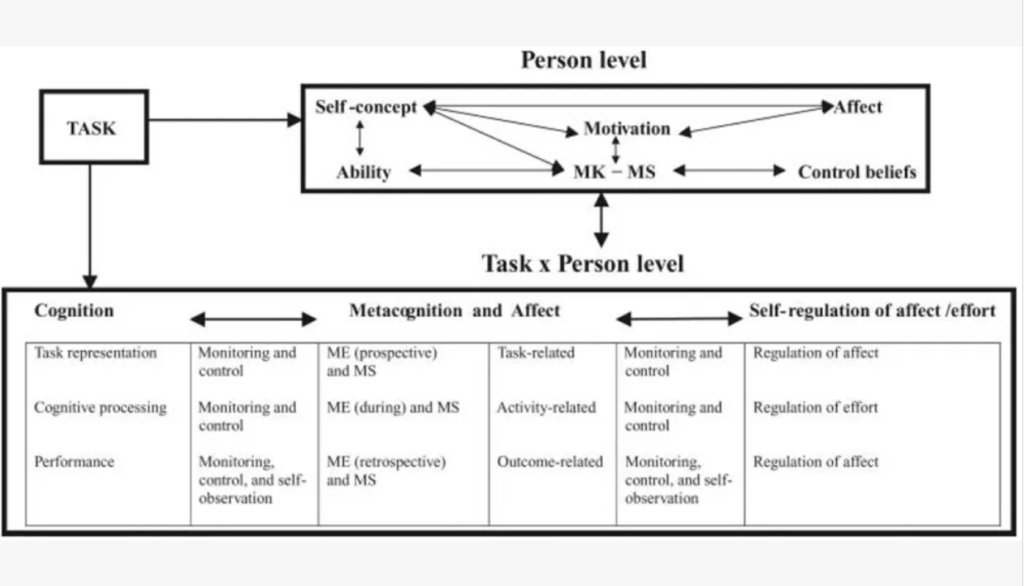
Image taken from A Review of Self-regulated Learning: Six Models and Four Directions for Research[5]
Efklides’ model, called MASRL (Metacognitive and Affective Model of Self-Regulated Learning), acts as a bridge.
It takes the “thinking about thinking” (metacognition) and blends it deeply with how we feel (affect/motivation).
Efklides looks at the student from two different perspectives:
- the Person Level (Macro) and
- the Task level (Micro).
Think of the Person Level as your “Default Setting.”
It is everything you bring to the table before you even touch a specific assignment.
It is somewhat of a “top-down” approach because your general goals and personality dictate how much effort you decide to give.
Efklides identifies seven things that make up who you are as a learner:
- Cognition: Your actual abilities and what you already know.
- Motivation: Why you want to learn (e.g., “I want a good grade” or “I love this subject”).
- Self-Concept: Your belief about yourself in that subject (e.g., “I am a math person” or “I’m bad at writing”).
- Affect: Your general moods and emotions.
- Volition: Your “willpower”—your ability to stay focused even when things get hard or boring.
- Metacognitive Knowledge: What you know about how learning works (e.g., “I know I learn better with diagrams”).
- Metacognitive Skills: Your ability to actually apply those learning strategies.
Why SRL Matters So Much in a Self-Paced Curriculum
A self-paced curriculum gives students room to slow down on difficult topics and move more quickly through material they already understand.
That flexibility can make learning more personalized and less rigid.
But self-pacing also means that students must make more decisions for themselves: when to study, how long to stay with a lesson, when to review, and when to ask for help.
Research on online learning environments shows that SRL support matters greatly in these settings[6].
A 2022 meta-analysis reported a positive, moderate effect of SRL interventions on academic achievement in online and blended environments[3].
This is why self-paced education should never be confused with unsupported education.
Students do not become self-regulated simply because adults step back.
They become self-regulated when freedom is paired with structure, feedback, and guidance.
Research on online learning also indicates that teacher support, clear expectations, feedback, and modeled self-regulation positively influence learners’ SRL.
It can also help with students who struggle with lenient problems related to IEP such as ADHD, mild anxiety, dyslexia or other developmental challenges.
That is also why EduWW’s model is relevant.
Our approach does not frame self-paced learning as “figure everything out alone.”
Instead, it combines flexibility with deadlines, progress tracking, and tutor support so students can gradually build stronger self-regulation habits within a stable structure.
What Strong Self-Regulated Learning Looks Like in Practice
A stronger version of this article should not stop at theory. It should show students and parents what SRL looks like in everyday learning.
looks like in everyday learning.
1. Turning goals into concrete plans
Many students set goals that are too vague to guide real action. “I will study science tomorrow” sounds good, but it does not create a clear response when the time comes.
Research on implementation intentions shows that turning goals into specific “if-then” plans improves goal attainment. A widely cited meta-analysis found this effect across 94 studies[7].
In practice, this means a student is more likely to follow through when the plan sounds like: “If it is 6:00 p.m. after dinner, then I will complete one biology lesson and answer five review questions.”
For EduWW students, this can be especially useful because self-paced learning works best when flexibility is supported by routine.
A calendar, weekly target, or lesson checklist can turn good intentions into daily habits.
2. Monitoring understanding instead of assuming it
A common weakness in self-regulation is mistaking familiarity for mastery.
Students may reread notes and feel comfortable with the material, but still struggle when they need to recall or apply it without help.
Research on practice testing shows that students who use practice tests often outperform students in non-testing conditions such as restudying[8].
In other words, checking memory actively is usually better than only reviewing passively.
After a lesson, students should try to explain the topic from memory, answer a few questions without notes, or summarize the main idea aloud before checking what they missed.
3. Spacing review instead of cramming
Students in flexible systems can be tempted to postpone work and then cram.
But research on distributed practice shows that spaced learning leads to better long-term results than massed practice.
A recent meta-analytic review of classroom learning found a moderate effect in favor of distributed over massed practice[9].
In practical terms, that means students should not treat a lesson as “done forever” after one session.
A better strategy is to revisit key material later through short reviews, low-stakes quizzes, or cumulative tasks.
4. Managing motivation, emotions, and distractions
SRL also includes the regulation of motivation and emotion, not just planning.
That matters because students do not usually fall behind only because they forgot a deadline.
They also fall behind because they feel overwhelmed, discouraged, bored, or distracted.
Review literature explicitly includes emotional and affective regulation as part of SRL, and teacher support in online settings has been linked to stronger student self-regulation[1].
Self-paced education actually suits well because students can return to weaker topics and build review into their weekly routine instead of waiting until a major test.
This means that students should be taught simple responses to difficult moments.
In case a lesson feels frustrating, break it into smaller parts. If attention is weak, reduce distractions and study in shorter focused sessions.
If motivation drops, return to a small target instead of waiting for perfect energy.
5. Asking for help at the right time
One of the most important habits in self-regulated learning is knowing when to ask for help.
Many students think they should solve everything on their own, but staying stuck for too long often leads to frustration and wasted time.
Smart learners recognize when they have reached the limit of what they can figure out independently.
Instead of repeating the same approach, they take action.
That might mean asking a tutor a specific question, reviewing an example, or requesting clarification on a concept that is unclear.
In a self-paced environment, this skill becomes even more important.
Without a fixed classroom schedule, students need to decide for themselves when to move forward and when to pause and seek support.
6. Reflecting with self-assessment, not just with feelings
Students are often told to “reflect,” but reflection becomes much more useful when it is tied to criteria.
That means students should ask more than “Did this feel easy?” Better questions are: “What did I actually remember without notes?” “Where did I lose marks?” “Which strategy helped most?” and “What will I do differently next time?”
7. Explaining ideas in your own words
Another valuable addition to the article is self-explanation.
A 2025 meta-analysis in digital learning environments found that self-explanation had at least a medium effect on academic performance, and it was even more effective in learner-centered pacing environments than in system-centered ones[10].
In practice, this means students should not only read or watch a lesson.
They should pause and ask: “Why does this make sense?” “How does this connect to what I learned before?” or “Could I explain this to someone else?”
When students explain ideas in their own words, they are more likely to notice gaps in understanding and build stronger conceptual learning.
How EduWW’s Curriculum Supports SRL
At EduWW, self-regulated learning is not a separate topic sitting outside the curriculum.
It is part of how students learn in a self-paced online school.
We already explained how self-regulated learning connects self-pacing with planning, progress monitoring, motivation, and help-seeking. We also explained how students receive support through deadlines, progress tracking tools, and tutors.
That matters because research suggests students build SRL more effectively when autonomy is combined with structure rather than with total independence.
Younger learners especially benefit from explicit support, and online learners benefit when teachers provide clear instructions, feedback, and models of self-regulated behavior.
In that sense, EduWW’s structure is not there to reduce independence. It is there to help students develop independence more successfully over time.
Final Thoughts
Self-regulated learning is one of the most important skills a student can develop in modern education.
It helps students plan, stay engaged, monitor understanding, ask for help, reflect productively, and adapt when learning becomes difficult.
Research supports its importance, and research also shows that these skills can be taught and strengthened rather than simply expected.
For a self-paced school like EduWW, that makes SRL especially relevant.
Academic success in a flexible environment means building the habits and strategies that allow students to use freedom well.
When students learn how to regulate their own learning, they do not only perform better in school. They build a skill that can support them far beyond it.
References:
- https://pmc.ncbi.nlm.nih.gov/articles/PMC5408091/
- https://www.sciencedirect.com/science/article/abs/pii/S1747938X08000080
- https://www.tandfonline.com/doi/full/10.1080/0144929X.2022.2151935
- https://www.academia.edu/6378237/How_do_students_self_regulate_Review_of_Zimmerman_s_cyclical_model_of_self_regulated_learning
- https://www.frontiersin.org/journals/psychology/articles/10.3389/fpsyg.2017.00422/full
- https://research.tudelft.nl/en/publications/supporting-self-regulated-learning-in-online-learning-environment/
- https://www.scribd.com/document/974874664/1-s2-0-S0065260106380021-main
- https://www.researchgate.net/publication/315706448_Rethinking_the_Use_of_Tests_A_Meta-Analysis_of_Practice_Testing
- https://www.researchgate.net/publication/392383866_The_Distributed_Practice_Effect_on_Classroom_Learning_A_Meta-Analytic_Review_of_Applied_Research
- https://link.springer.com/article/10.1007/s10648-025-10001-x